In December of 2004, Google announced partnerships with several high-profile university and public libraries, including the University of Michigan, Harvard (Harvard University Library), Stanford (Green Library), Oxford (Bodleian Library), and the New York Public Library. According to press releases and university librarians, Google planned to digitize and make available through its Google Books service approximately 15 million volumes within a decade.
If all these books are digitized into computers, then it should be easy to search these books for words like emotions. Then you could count how many times these words appeared in book, by their publication date. This may be an indicator of how popular these emotions are in popular use.
Fortunately Google has done this work for you in a program called the n-gram . The n-gram is used to find how many times a word is used in books from the year 1600 on. So if you want to find out if an emotion is increasing in popular usage or declining in popular usage you can use this free tool to find out.
The n-gram can be used for free at Google https://books.google.com/ngrams
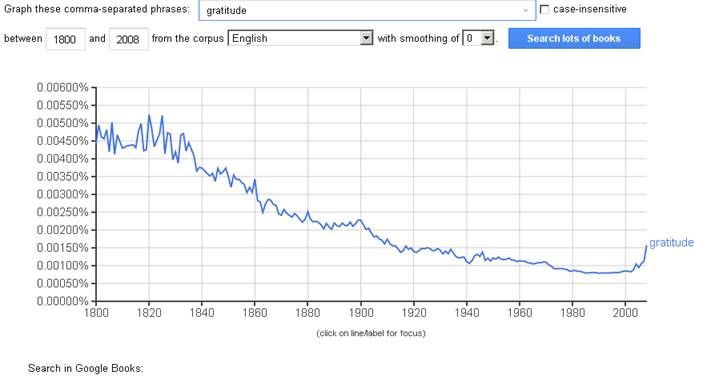
One example is of the word ‘Gratitude’ which can be seen to decline in popular usage until 2000 and then begin to become more popular.
Note: Abraham Maslow in his study of human needs found that there were some basic biological needs that every human being had. He also found that as soon as these needs were met, people wanted to have other needs fulfilled. They were originally just wants but then became needs in the minds of the individual. (see Maslow’s Hierarchy of needs here .)
Then along came an Italian economist, named Vilfredo Pareto, whose work led to the finding that indicated that 80% of the people who buy a product will buy 20% of the product, while 20% of the people who buy something will buy 80% of the product being sold. These people may be buying for emotional reasons, not because the absolutely 'need' the product.
Take Coca-Cola for example. According to the rule, sometimes called ‘the law of the heavy half’, 80% of the people who buy Coke will buy only 20 % of the Coke sold. Perhaps it is because they are thirsty. This leaves 20% of the people who buy Coke, and they buy 80% of the Coke that is sold.
It may be that they buy this amount for some emotional reason beside that fact that they are thirsty.